A PAGCOR license is an official authorization issued by the Philippine Amusement and Gaming Corporation that grants operators the legal right to offer gaming services in the Philippines, like Juan 365. It is the government’s seal of approval — a guarantee that the licensed operator has met strict regulatory standards for fairness, security, and accountability. For Filipino players, understanding what a PAGCOR license is and what it represents is the first step toward making safer and more informed gaming choices.
The Legal Basis of a PAGCOR License
The authority to issue a PAGCOR license is rooted in Presidential Decree No. 1869, which grants the Philippine Amusement and Gaming Corporation the exclusive power to regulate, operate, and license all forms of gaming activities in the country. This legal foundation gives every license issued by the agency the full weight of Philippine law — making it one of the most legally significant authorizations a gaming operator can hold in the country.
Beyond its founding decree, PAGCOR’s licensing authority is further reinforced by:
- Republic Act No. 9487 — Which extended PAGCOR’s franchise and reaffirmed its mandate to regulate and operate games of chance nationwide.
- Executive Orders and PAGCOR Board Resolutions — Which define the specific requirements, conditions, and standards that operators must meet to obtain and maintain a license.
- Anti-Money Laundering Laws — Licensed operators are required to comply with the Anti-Money Laundering Act (AMLA), ensuring that gaming platforms are not used for financial crimes.
This robust legal framework ensures that a PAGCOR license is not merely a business permit — it is a government-backed guarantee of compliance, integrity, and accountability.
Types of PAGCOR Licenses
Not all PAGCOR licenses are the same — the agency issues different types of licenses depending on the nature and scope of the gaming operation. Each license type comes with its own set of requirements, conditions, and regulatory standards.
The main types of licenses issued by the agency include:
- Casino License — Granted to operators of land-based casinos, covering table games, slot machines, and other gaming facilities open to the public.
- Online Gaming License — Issued to operators of digital gaming platforms, authorizing them to offer casino games, sports betting, and other gaming products to Filipino players through the internet.
- Electronic Gaming License — Covers operators of electronic gaming machines and e-bingo facilities, typically found in smaller gaming venues outside of major casinos.
- Sports Betting License — Authorizes operators to offer wagering on local and international sporting events, both in physical locations and online.
- Gaming Support License — Issued to companies that provide gaming-related services such as software development, equipment supply, and technical support to licensed operators.
Understanding which type of license a platform holds is important for players — as it confirms that the operator is authorized specifically for the type of gaming they are offering.
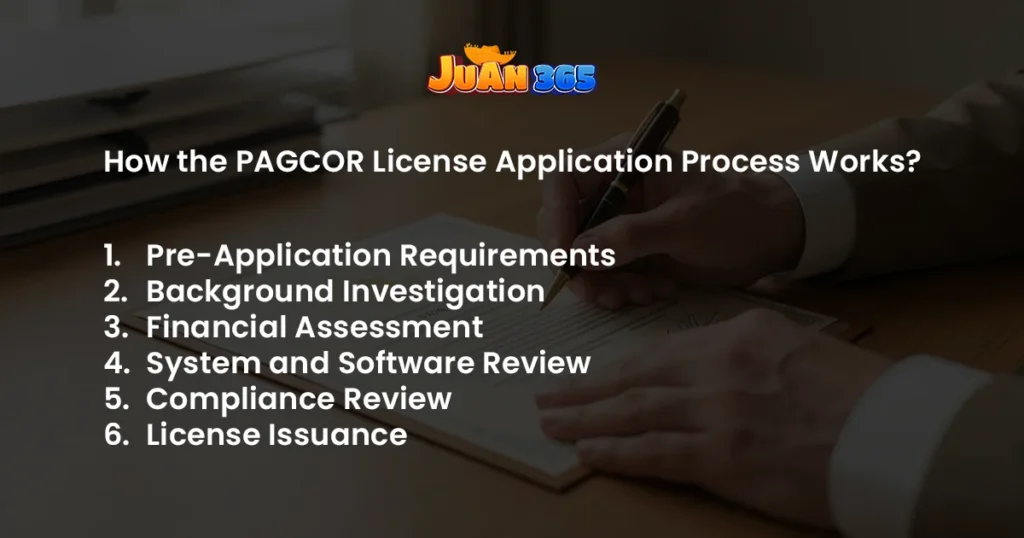
How the PAGCOR License Application Process Works
Obtaining a PAGCOR license is a rigorous and thorough process — designed to ensure that only qualified, financially stable, and legally compliant operators are granted the authority to offer gaming services in the Philippines. The application process involves multiple stages of evaluation before a license is issued.
The process generally follows these steps:
- Pre-Application Requirements — Applicants must first submit a letter of intent along with preliminary documentation, including proof of business registration, corporate structure, and initial financial statements.
- Background Investigation — The agency conducts a thorough background check on all key personnel, directors, and major shareholders to verify their integrity and ensure they have no criminal records or regulatory violations.
- Financial Assessment — Applicants must demonstrate sufficient capitalization and financial stability to operate a gaming business and cover potential player liabilities.
- System and Software Review — For online gaming operators, all gaming systems, platforms, and software must be submitted for technical review and certification to ensure fairness and security.
- Compliance Review — Applicants must demonstrate full compliance with all applicable laws, including anti-money laundering regulations and data privacy requirements.
- License Issuance — Once all requirements are satisfied and the application is approved, the agency issues the license along with specific conditions and operating guidelines the operator must follow.
The entire process reflects the agency’s commitment to maintaining a gaming environment that is safe, fair, and fully accountable to the public.
What Operators Must Do to Keep Their License
Obtaining a PAGCOR license is only the beginning — maintaining it requires ongoing compliance with a strict set of regulatory obligations. The agency conducts regular monitoring and audits to ensure that all licensed operators continue to meet the standards they were evaluated against during the application process.
Key compliance requirements include:
- Regular Reporting — Licensed operators must submit periodic financial and operational reports to the agency, providing full transparency on their revenues, player activity, and business operations.
- Renewal Requirements — Licenses are not permanent and must be renewed on a regular basis. Operators must demonstrate continued compliance with all regulatory standards to qualify for renewal.
- Ongoing Background Checks — Any changes in ownership, key personnel, or corporate structure must be disclosed and approved by the agency to ensure the integrity of the operation is maintained.
- System Updates and Audits — Online gaming operators are required to submit any updates to their gaming systems and software for review and re-certification, ensuring continued fairness and security.
- Responsible Gaming Compliance — Operators must maintain and actively enforce responsible gaming measures, including self-exclusion programs, bet limits, and age verification protocols.
- Anti-Money Laundering Compliance — Ongoing adherence to AMLA requirements is mandatory, including the filing of suspicious transaction reports when necessary.
Failure to meet any of these obligations can result in sanctions, suspension, or outright revocation of the license — a clear signal that the agency takes compliance seriously and does not hesitate to act against operators that fall short.

What a PAGCOR License Means for Players
For Filipino players, a PAGCOR license is more than just a regulatory formality — it is a direct assurance of safety, fairness, and accountability. When a platform carries this license, it means the operator has been thoroughly vetted by the government and is held to standards designed specifically to protect the player.
Here is what a valid license means for you as a player:
- You are playing on a legal platform — Licensed operators are authorized by the government, meaning your participation is legally protected under Philippine law.
- Your funds are secure — The agency requires licensed operators to maintain sufficient funds to cover player deposits, winnings, and withdrawals at all times.
- The games are fair — All gaming systems on licensed platforms are tested and certified to ensure random and unbiased outcomes — no manipulation, no rigged results.
- Your data is protected — Licensed operators are required to handle personal and financial information in accordance with the Data Privacy Act of the Philippines.
- You have legal recourse — If a dispute arises, you have the right to file a formal complaint directly with the agency against the licensed operator — a protection that simply does not exist on unlicensed platforms.
Platforms like Juan 365 operate under a valid PAGCOR license, giving Filipino players the confidence that every game, transaction, and interaction on the platform meets government-mandated standards.

How to Verify if a Platform Has a Valid PAGCOR License
Knowing how to verify a platform’s PAGCOR license is one of the most practical skills a Filipino player can have. With the growing number of online gaming platforms in the country, being able to distinguish a legitimate operator from a fake one can protect you from fraud, financial loss, and legal risk.
Here are the steps to verify a platform’s license:
- Check the Platform’s Website — Legitimate operators are required to display their license information prominently on their website. Look for a license number, issuing authority, and validity period — typically found in the footer or on a dedicated licensing page.
- Visit the Official PAGCOR Website — The agency maintains an updated list of all licensed operators on its official website. Cross-referencing a platform’s name or license number against this list is the most reliable way to confirm its legitimacy.
- Look for the License Number — Every valid license comes with a unique license number. If a platform claims to be licensed but cannot provide a specific license number, treat it as a red flag.
- Contact PAGCOR Directly — If you are still unsure, you can reach out to the agency directly through its official channels to verify a platform’s licensing status.
- Check for HTTPS Encryption — While not a direct indicator of licensing, a secure website with HTTPS encryption is a basic standard that all legitimate platforms should meet.
When in doubt, always verify first before signing up or depositing. Platforms like Juan 365 make this easy by prominently displaying their PAGCOR license information — a straightforward sign of transparency and legitimacy.
Conclusion
A PAGCOR license is the single most important indicator of trust and legitimacy in the Philippine gaming industry. It represents the government’s assurance that an operator has met the strictest standards of fairness, security, and accountability — and that players are fully protected under Philippine law.
Whether you are a first-time player or a seasoned one, always make it a habit to verify a platform’s license before playing. Staying informed through reliable gaming guides and choosing a licensed operator like Juan 365 is the simplest and most reliable way to ensure that your gaming experience is safe, fair, and legally protected.
Frequently Asked Questions (FAQs)
How long is a PAGCOR license valid?
A PAGCOR license is typically valid for a specific period — usually one to three years depending on the license type — after which operators must apply for renewal and demonstrate continued compliance with all regulatory standards.
Can a PAGCOR license be revoked?
Yes. The agency has the full authority to suspend or revoke a license if an operator is found to be in violation of its regulatory standards — including failure to comply with anti-money laundering laws, responsible gaming requirements, or other conditions of the license.
Is a PAGCOR license the same as other gaming licenses in Asia?
No. Each country has its own gaming regulatory body and licensing framework. A PAGCOR license is specific to the Philippines and authorizes operators to offer gaming services within the country. It is not interchangeable with licenses issued by regulators in other jurisdictions.
Do all online casinos in the Philippines need a PAGCOR license?
Yes. Any operator offering gaming services to Filipino players is required by law to hold a valid license from the agency. Operating without one is illegal and exposes both the operator and players to significant legal and financial risks.
What should I do if a licensed platform violates my rights as a player?
You have the right to file a formal complaint directly with the agency through its official channels. Licensed operators are accountable to PAGCOR, which means the agency has the authority to investigate complaints and impose sanctions on operators found to be in violation.